Sunday, 12 July 2015

Fire in the Sky

July 10 2015

Aurora
Aurora Borealis
Nikon D610 +Rokinon 14mm f2.8
30 secs ISO 3200  
 
The weekend trip down at Pasqua Lake with some friends turned out to be a great night. I purposely did not bring  my telescope rig this time since the skies looked a bit overcast with all the forest fires up in the North. The Milky Way was hardly popping out, with the low horizon so hazy that i decided its not worth spending time to photograph it. Then i received an aurora activity alert on my phone. Mother nature decided to put up a show that night. The sky lit up with shimmering waves of green and purple light.  I could hardly wait to start shooting as i climbed a nearby hill to have a better view. It was such a beautiful sight. With gentle warm breeze blowing, it was so quiet  as i sat there alone atop of the hill, looking up the stars and marveling how vast and beautiful our universe is.

Thursday, 2 July 2015

Pinwheel Galaxy M101


June 21 2015
Pinwheel Galaxy
Nikon D610 + Skywatcher ED80
Skywatcher EQ-3 Synscan + Orion Autoguider 
10 minutes x 3 @ iso 1600 
Stacked in DeepSkyStacker

The Pinwheel Galaxy or Messier 101 is a spiral galaxy located at the constellation of Ursa Major, where the well known Big Dipper lies. During summer months, M101 is almost directly overhead . This image was taken at Cypress Hills Dark Sky Preserve without the use of any filters. I have tried using a UHC-S filter for this object but the resulting image was too dim even in dark skies. Imaging this faint galaxy under light polluted skies is almost impossible. You will like just get a blob of light, it's faint spiral arms will be extremely hard to resolve. A ten minute exposure @ISO 1600, the spiral arms became visible. Stacking three 10 minute exposure and more details can be seen. I am only limited by my telescope size as an 80mm scope is not really designed for targets this faint.

Sunday, 28 June 2015

A closer look at Cygnus with 85mm f1.8


Deep Sky objects at Cygnus Constellation and some "air glow" not Aurora.


Nikon D610 + EQ-3 Sysncan mount
When humidity levels are too high after a thunderstorm, dew forming on the main objective of the scope is a major problem of any astro -imager.  And that is what exactly happened on my imaging session one night at Saskatchewans Cypress Hills Inter-provincial Park. So i have to pack up the scope and use a normal DSLR lens instead, mounted on a tracking mount i was still able to take pictures of the sky on a wider view. The Nikkor 85mm f1.8 lens proved to be an excellent astro lens. Corner sharpness are excellent even wide open and coma is very negligible. When used on a tracking mount, f1.8 is even too much. I had to stop down to f2.8 to avoid over exposure, or  just adjust the ISO but sometimes i can be lazy. =D

Thursday, 25 June 2015

Cypress Hills Dark Sky Preserve


June 20 2015
The Lagoon Nebula (M8)
The Lagoon Nebula (M8) and Trifid Nebula (M20)
Nikon 610 + Skywatcher ED80
Skywatcher EQ-3 Synscan + Orion Autoguider 
10 minutes x 3 @ iso 3200 
Stacked in Photoshop

 Finally after weeks of waiting, i finally had another chance to re-visit a real dark sky preserve here in Western Canada, the Cypress Hills Inter-provincial Park. A four hour drive from the city, this park boasts one of the darkest skies in North America. We stayed for three nights but only on the last night i was able to get lucky when there was hardly any wind, cloud and the humidity was at acceptable levels. I wasted no time setting up my scope at the first sight of Polaris and at around 1 a.m when the Milky Way is high enough on the horizon, i slewed the scope towards the constellation of Sagittarius  and did a 10 minute initial exposure. I was elated with the results. The Lagoon Nebula stood out  clearly amidst the sea of stars on my camera screen.
I was able to take twenty more minutes of exposure for a total of thirty as i wanted to image other subjects before the skies get too light .

My Orion Starshoot Autoguider was working wonderfully that night, keeping my mount slow and steady. Dew became a problem later at around 2 a.m so i had to resort on using my wife's hair dryer on the main scope and autoguider.

It was an exhausting 3 days with hardly any sleep at night. The first day dew was such a big problem that i had to pack up the scope. The second night was still very wet with humidity but i had a fan heater to combat the dew, however my autoguider was going nuts that night. The third and last night was the best. Mother nature just cooperated.

This shot is a widefield shot of the  Lagoon Nebula or known as Messier 8 (M8) and on the upper right corner is the equally beautiful Trifid Nebula (M20).

Wednesday, 17 June 2015

Milky Way at Rowans Ravine

June 13 2015
Milky Way, light pollution & a hint of aurora?

Milky Way
Nikon D7000 +Rokinon 14mm f2.8
30 secs x 11 @ iso 3200 
Stacked in Photoshop

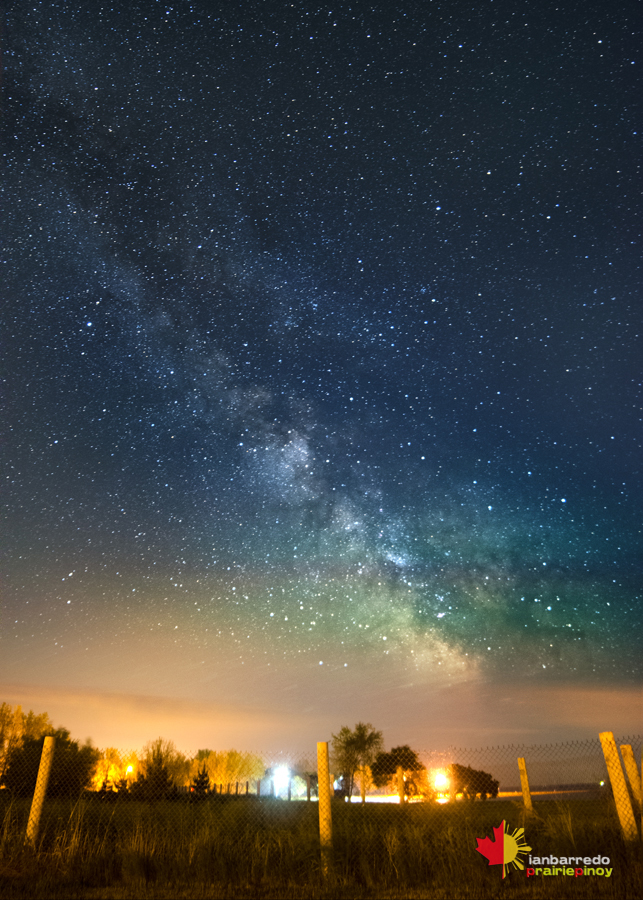
Here is a shot of the Milky Way at Rowans Ravine Provincial Park last weekend. The problem in shooting within parks is that there will always be some sort of light pollution and our campsite was no exception, even though  it is decently dark enough for some astrophotography, . There was a streetlight ablaze right next to our tent and where my telescope is setup. So i roamed around the dark and found an open spot where the Milky Way is rising, it is a good spot albeit a couple of lights on the beach contributed to the already noticeable glow on the horizon. Then low clouds rolled in, and i thought i remembered receiving an aurora alert that night. But i couldn't see any noticeable auroral activity. When i was processing the pictures and stacking them later, i saw a faint green glow on the horizon and i thought that must be the aurora after all.


 June 13 2015
The Summer Triangle
Milky Way
Nikon D7000 +Rokinon 14mm f2.8
30 secs x 11 @ iso 3200 
Stacked in Photoshop

Here is another shot with a different play in white balance. The summer triangle stars Deneb on the left, Altair on bottom right and Vega on the top at almost overhead. They are seen as the brightest stars on this plane of the Milky Way at summer. There is that faint green glow again on the bottom.
Deneb is very interesting since it is surrounded with so much nebulosity and interstellar dust as seen here on a nearby star Sad'r  http://prairiepinoyastro.blogspot.ca/2015/06/baader-uhc-s-filter-first-impressions.html.

Next stop will be Cypress Hills. Now if only the weather will cooperate.

Sunday, 14 June 2015

Weekend Camping at Rowans Ravine

  June 13 2015
Exploring the galaxy

It was a good weekend camping at Rowans Ravine, though our campsite was plagued by a nearby streetlight, still i was able to capture some decent images of the night sky. The real problem that night was not the clouds, or the cold temperature nor the wind. It was the dew! Yes dew is major enemy of any observer,. In less than an hour after my rig is up and running, dew started to form on the main scope and on the guide scope. I heard the pings of the guiding software complaining of losing the guide star. I checked, the skies were clear, not a cloud in sight. When i check the main objective, it was dripping wet with dew. The humidity was so high that night that i had no choice but to pack and and go to sleep. Less than 10 decent images were taken and that was it. Though it was stll fun,. I had a great time just looking up and watching the Milky Way rise.

 June 13 2015
Milky Way over the campsite

Thursday, 11 June 2015

Veil Nebula


June 6 2015
The Western Veil (also known as Caldwell 34)

Western Veil Nebula
Nikon D610 +Skywatcher ED80 + Orion Starshoot Autoguider
Skywatcher EQ-3 Synscan
5 mins x 7 @ iso 800 with Baader UHC-S.
Stacked in DSS + Photoshop

Here is another celestial object taken from my light polluted backyard. The Veil Nebula is a supernova remnant which occurred thousands of years ago. This nebula is so large that it is measured at six times the diameter of the full moon, but it is very diffuse. What is pictured here is just the western veil or called the Witches Broom which is less than a quarter of the size of the whole nebula. The veil is part of the Cygnus loop within the plane of the Milky Way. The bright star is called 52 Cyg.
I had a hard time processing this image partly because the nebula is so faint that even at 5 mins exposure i can  hardly see it and i suspect my ISO is too low at 800. The UHC filter however helped a lot reducing the skyglow which makes the image look orange.
Stretching the image introduced a lot of noise and artifacts but i was able to bring out the green color of Oxygen III emission which this nebula is known for. Making more adjustments on the midtone levels will bring out some more wispy details but the image will be degraded too much. I will definitely try to capture this object again on the next chance that will come.